
- PlayinMatch99
- PlayinMatch Exchange
PlayinMatch Exchange — Real Lay Slips at a 2% Fee on Net Wins, Liability Shown
Lay a team on the PlayinMatch exchange and the slip prints, in rupees, what you could lose before you confirm anything. Markets you finish ahead on pay a 2% fee on the net figure. Markets you lose pay none.

Sample match-odds market with one back slip and one lay slip
Prices are illustrative. On a live market they shift with every ball, and the slip recalculates each time they do.
Back slip on Team A at 2.40
- Stake
- ₹1,000
- Profit if Team A wins
- ₹1,400
- Loss if Team A loses
- ₹1,000
- Fee on a winning market
- ₹28
Lay slip on Team A at 2.44
- Backer's stake you accept
- ₹1,000
- Liability if Team A wins
- ₹1,440
- Profit if Team A loses
- ₹1,000
- Fee on a winning market
- ₹20
Read the two slips side by side and the whole exchange makes sense. On the left, your downside is the stake and nothing else. On the right it is ₹1,440, a bigger number then the ₹1,000 you typed, because you have agreed to pay a winner at 2.44. PlayinMatch shows that figure on the lay slip before the confirm step, so there is never a moment where you find out afterwards.
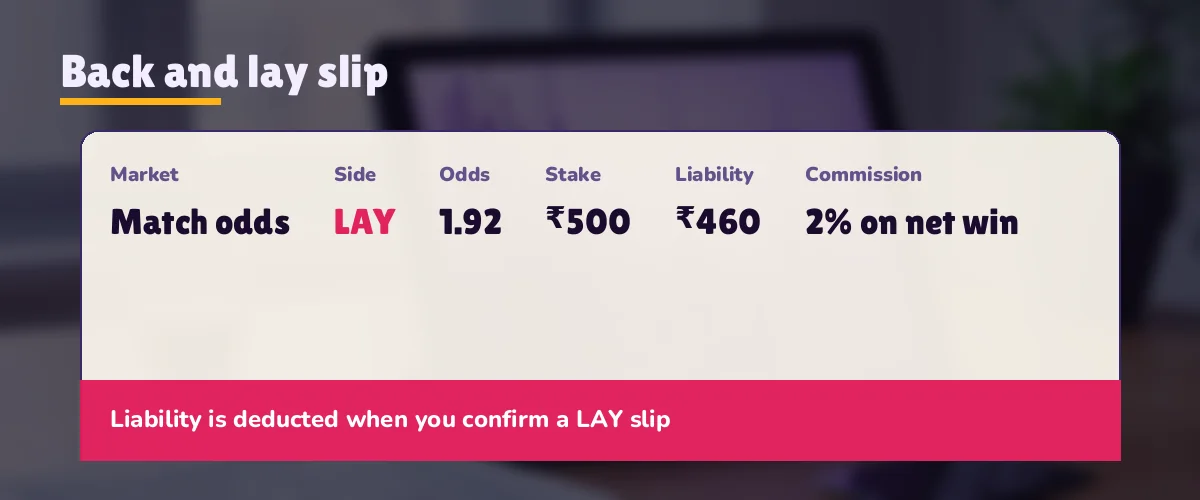
PlayinMatch Exchange Back and Lay — Clear Liability Before You Confirm
Start with the left slip in the replica. ₹1,000 on Team A at 2.40. A Team A win returns ₹2,400 to the wallet, of which ₹1,400 is profit; a Team A defeat costs the ₹1,000 and not a rupee more. Backers on PlayinMatch never see a liability line for that reason.
The right slip is the reverse trade on the same team. Somebody out there wants Team A at 2.44 for ₹1,000, and your lay accepts that wager. Team A lose and their ₹1,000 lands in your PlayinMatch wallet. Team A win and you owe them ₹1,440 in profit, which is exactly what the liability row on the slip already told you.
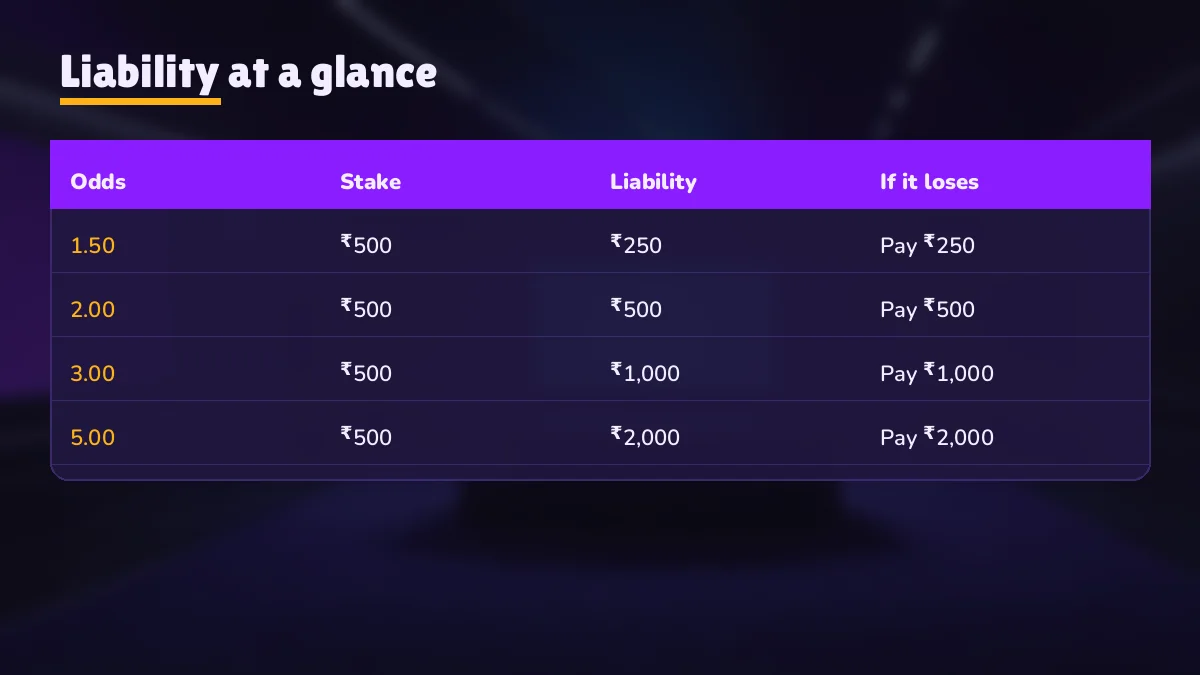
The sum is short. Take the lay price, subtract one, multiply by the stake. ₹1,000 laid at 2.44 gives 1.44 × 1,000, which is ₹1,440. Lay ₹2,500 at 1.30 and the liability drops to ₹750, because short prices carry small payouts. Lay ₹500 at 8.00 and it jumps to ₹3,500.
Those last two examples are the reason the PlayinMatch lay slip leads with liability rather than stake. A ₹500 lay sounds small. At 8.00 it is not small at all. Most people who get surprised on an exchange get surprised exactly here, on long-priced lays, where a modest stake hides a large exposure.
Placing a first lay on PlayinMatch, in the order the screen asks for it:
- Open the match and find the selection you think will not win. Tap the price in the Lay column, not the Back column.
- The slip opens with that price filled in. Type the stake — the amount you are willing to win if the selection fails.
- Read the liability line. That is your real risk. If it is bigger than you planned, cut the stake until it is not.
- Confirm. If only ₹1,400 of a ₹2,000 lay finds a backer, expect two entries afterwards — a matched ₹1,400 and a waiting ₹600 — rather than one.
Step three is the one people skip when a match gets busy, and it is the one the slip was designed around. A stake of ₹2,000 on a 4.50 lay reads like a ₹2,000 bet; the liability line says ₹7,000. Same slip, very different evening if the outsider gets home. Read that line every time, even on a lay you have placed a dozen times before.
On any exchange the liability is set aside from your balance while the bet is open and returned or paid out when the market settles. So a wallet showing ₹5,000 with one ₹1,440 lay running has ₹3,560 free to use. People sometimes read that as money missing. It is not missing; it is reserved against the open position, and it comes back the moment the market settles in your favour.
One more detail on the replica above. The back price (2.40) sits a little below the lay price (2.44) on the same team. The gap is the spread between what backers are asking and what layers are offering, and on busy PlayinMatch cricket markets it is usually thin. On quiet markets (a lower-tier league at an odd hour, say) it can be wide enough to matter, so look at both columns before you tap.
PlayinMatch Exchange Commission — a Proven 2% on Net Wins, Worked Through
The PlayinMatch exchange takes 2% of what you win, measured on the net result of each market. It does not touch your stake. It does not touch a market you lose. And because it is netted, a back and a lay on the same match are settled together before the fee is worked out, not slip by slip.
The table runs six cases through the same prices as the sample slips, plus one pair where a back is followed by a lay on the same team.
| Position | Outcome | Net on market | 2% fee | You keep |
|---|---|---|---|---|
| Back ₹1,000 at 2.40 | Team A wins | +₹1,400 | ₹28 | +₹1,372 |
| Back ₹1,000 at 2.40 | Team A loses | −₹1,000 | ₹0 | −₹1,000 |
| Lay ₹1,000 at 2.44 | Team A loses | +₹1,000 | ₹20 | +₹980 |
| Lay ₹1,000 at 2.44 | Team A wins | −₹1,440 | ₹0 | −₹1,440 |
| Back ₹500 at 2.10, later lay ₹500 at 1.80 | Team A wins | +₹150 | ₹3 | +₹147 |
| Same back and lay pair | Team A loses | ₹0 | ₹0 | ₹0 |
The last two rows are the ones that show why netting matters. Taken alone, the back slip in that pair won ₹550 and the lay slip lost ₹400. Charged slip by slip, the fee would be 2% of ₹550, or ₹11. Charged on the net ₹150, it is ₹3. On a match where you go in and out several times, that gap adds up over a season.
Check it yourself on PlayinMatch: open the settled statement after a market closes. Each market shows one line for the result and one for the commission. If the commission line is 2% of the net figure, the arithmetic is right. If you lost on the market, there should be no commission line at all.
How does 2% compare with what a sportsbook takes? Hard to put a single number on it, because a sportsbook does not charge a visible fee. Its margin lives inside the odds, so every price you see is a shade shorter than a fair one, whether you win or lose. The PlayinMatch fee is the opposite design: prices come from other punters, and the house only takes its cut when you finish a market ahead.
Winnings land in the same wallet you play from. Moving them out to a bank is a separate step — IMPS payouts and their timings sit on the PlayinMatch withdrawal time page.
PlayinMatch Exchange Session and Fancy Lines — Live Runs Markets in One Slip
Beyond the Team A v Team B rows in the replica, a cricket match on PlayinMatch grows extra rows once the innings starts: session numbers and fancy lines. On a T20 night these often fill more slips than match odds do.
Session rows on PlayinMatch ask one question each: how many runs will the batting side have at a set over mark — 6, 10, 20? Two numbers answer it, the lower one labelled No and the higher labelled Yes. Say the 6-over line reads 48 and 50. Taking No at 48 means you are calling the total under 48. Taking Yes at 50 means you are calling 50 or more. The rate beside each number tells you the payout per rupee, and like everything else on the exchange it moves ball by ball as runs come and wickets fall.
Fancy is the looser family of lines around the same match. Runs for an opening batter, a partnership total, the over in which a wicket falls — the set that opens depends on the fixture and the stage of the innings, so do not expect the same list every night. Lines also tend to close (suspend) for a moment around a wicket or a review, then reopen at a new number.
Worked session example. You take Yes at 50 for ₹1,000 at even rate on the 6-over line. Six overs end at 53: you win ₹1,000. They end at 49: you lose ₹1,000. They end at exactly 50: Yes wins, since 50 is the line you called "or more" on. The PlayinMatch slip shows the stake and the exposure for the line before you confirm, same as a lay.
Are session and fancy covered by the same 2% rule? The fee is set on net wins across the exchange, and these lines live on the exchange. The cleanest check is the same as before — the settled statement lists a commission line per market, and a session line that you won shows its deduction there.
One practical point about these PlayinMatch markets: they move faster than match odds. A session number can jump two or three runs on a single boundary. If you are watching a score that lags the play by a few seconds, you are pricing an innings that has already changed. The section on the live score below comes back to this.
PlayinMatch Exchange Matched and Unmatched Bets — Quick Ways to Read Your Slip
An exchange can only take your bet if somebody on the other side accepts it. On PlayinMatch that splits every slip into two possible states, and knowing which one you are in saves a lot of confused messages to the support desk.
Matched means another punter has taken the opposite side at your price. The bet is live, the liability is reserved, and it settles with the market. Unmatched means your slip is waiting. You asked for a price nobody is offering yet, or you asked for more money than is available at that price.
Example. The best back price on Team A is 2.40 with ₹600 available. You submit a back of ₹1,000 at 2.40. The first ₹600 matches straight away. The other ₹400 sits unmatched at 2.40 until a layer arrives — or until you cancel it. Ask for 2.60 instead, above anything on offer, and the full ₹1,000 waits.
Common slip puzzles and what they usually mean:
- PlayinMatch bet placed but not in the matched list. Look in the the unmatched list first. Most of the time it is sitting there at the price you typed.
- Balance dropped more than the stake. That is a lay or a session exposre being reserved. It is part of the open position, not a deduction.
- Unmatched part disappeared after a wicket. On most exchanges, waiting in-play bets can be lapsed when a market suspends. Re-check the open bets after any suspension rather than assuming it is still there.
- 2.40 on the slip became 2.36 before confirm. A run or a dot ball shifted the market mid-typing. Take the new number or type your own and let it wait.
Leaving part of a PlayinMatch bet unmatched is not a mistake in itself. Some people deliberately sit at a better price and wait. Just remember that a waiting PlayinMatch slip can fill at any moment while the market is open, including after the situation that made you want it has changed.
PlayinMatch Exchange on the App — Same Secure ID on Android and Mobile Web
Nothing about the exchange changes on a phone. The same username, the same balance, the same open bets; a lay you placed on a laptop at 7 pm is in the open-bets list on the phone at 7:01.
There are two routes. The Android build is a direct APK of about 22 MB — the steps and version notes are on the PlayinMatch app download page. If you would rather not install anything, the PlayinMatch com mobile site runs in the browser with the same login.
Say you placed a lay at 8 pm and by 9 pm your provider has blocked the address you used (Indian ISPs do this to betting domains now and then). Log in on a mirror address. The PlayinMatch ID is the same, the balance is the same, and the open lay is still sitting in the list.
Small-screen habit worth keeping: on a narrow screen the back and lay columns sit close together, and it is easy to tap the wrong one. Before you confirm, read the slip heading. It should say Back or Lay plainly, and on a lay the PlayinMatch slip shows the liability line. If you meant to back and you see a liability figure, cancel and start again.
PlayinMatch Exchange vs Sportsbook Odds — Real Prices Set by Other Punters
The PlayinMatch exchange and a fixed-odds sportsbook can list the same match and still behave very differently. Short version of the differences:
- Who sets the price. On the exchange, other punters do, by offering and taking bets. On a sportsbook, the house sets it and you accept or walk away.
- Laying. Available on the exchange. A sportsbook only lets you back.
- The cost. A 2% fee on net market wins on the PlayinMatch exchange; a margin built into every price on a sportsbook, paid win or lose.
- Getting out early. On the exchange you can lay what you backed (or back what you laid) and close the position at the current price. On a sportsbook you wait for the result, unless a cash-out offer appears.
- Stake size. On a sportsbook, limits come from the house. On the exchange, the amount you get matched depends on what is available at your price.
In practice, exchange prices on a busy match tend to sit slightly longer than fixed odds on the same outcome, because there is no margin baked in. That is a tendency, not a rule. On thin markets the sportsbook can be the better number, and the only way to know is to compare the two on the night.
The full spread of PlayinMatch games, from the exchange to live dealer tables, is on the PlayinMatch game page; the sports and fixtures list is on PlayinMatch online live sports.
PlayinMatch Exchange With the Live Score — a 20-Second Strip Beside Your Slip
Plenty of PlayinMatch exchange users keep a score open next to the slip, and the site has one built for it. The PlayinMatch score strip for today's matches carries a strip for cricket, football and tennis that refreshes every 20 seconds.
Twenty seconds is fine for following a match. For pricing a session line it is a long time. In a T20 over, 20 seconds can cover a full delivery and the reaction to it, and the exchange price will usually move before the strip does. So treat the strip as context — the state of the innings, the required rate, who is batting — and treat the exchange price itself as the latest information on the screen.
A sensible way to work it: read the strip to understand where the match is, then read the PlayinMatch market to see where the money is. If the two disagree, the market has usually seen something the strip has not caught yet. Wait for the next PlayinMatch refresh before acting on the gap.
Before you lay anything, decide the biggest liability you would be comfortable seeing on a single slip, and keep to that number when the match gets loud. The exchange is for adults aged 18 and over, and only where betting is legal in your state.
PlayinMatch Exchange Searches — Top Related Pages on the Site
PlayinMatch Exchange Keywords — Clear Answers in One Fold
What the PlayinMatch exchange covers on this page
Back, lay, session and fancy on one PlayinMatch exchange balance
People reach this page searching for the PlayinMatch exchange, PlayinMatch exchange login or the PlayinMatch back and lay rules. Everything here sits on one account: match odds with back and lay, session runs lines with No and Yes numbers, and fancy lines that open around a cricket innings.
The fee and the liability in plain figures
The PlayinMatch exchange commission is 2% of the net win on each market, nothing on a losing market. Lay liability equals the stake times the lay price minus one, and the lay slip prints it before you confirm.
- PlayinMatch exchange fee
- 2% of net market profit, worked out after back and lay slips on the same market are netted
- Lay liability on the slip
- ₹1,440 when ₹1,000 is laid at 2.44, shown before the confirm step
- Unmatched PlayinMatch bets
- ₹400 of a ₹1,000 back at 2.40 can sit unfilled when only ₹600 is offered
Where the exchange connects to the rest of the site
The same PlayinMatch ID works on the Android app, the mobile site and any mirror address if one domain is blocked. The score strip refreshes every 20 seconds and payouts move by IMPS from the same wallet the exchange settles into.
PlayinMatch Exchange FAQ — Quick Answers on Fees and Liability
What is the PlayinMatch exchange?
It is the back-and-lay side of PlayinMatch. You take a price another user is offering, or post your own, on cricket match odds, session runs and fancy lines. A lay lets you bet against a team with the liability printed on the slip, and a market you win carries a 2% fee on net profit.
How much commission does PlayinMatch charge on the exchange?
Two percent of the net profit per market. Back Team A for ₹1,000 at 2.40, win ₹1,400, and PlayinMatch deducts ₹28, leaving ₹1,372. Finish a market down or level and nothing is deducted. Back and lay slips on one match are combined before the fee is worked out.
What does liability mean on a PlayinMatch lay bet?
Liability is the most you can lose on a lay bet if the selection wins. It equals your stake multiplied by the lay price minus one, so ₹1,000 laid at 2.44 carries ₹1,440 of liability. The PlayinMatch lay slip shows this amount before you confirm the bet.